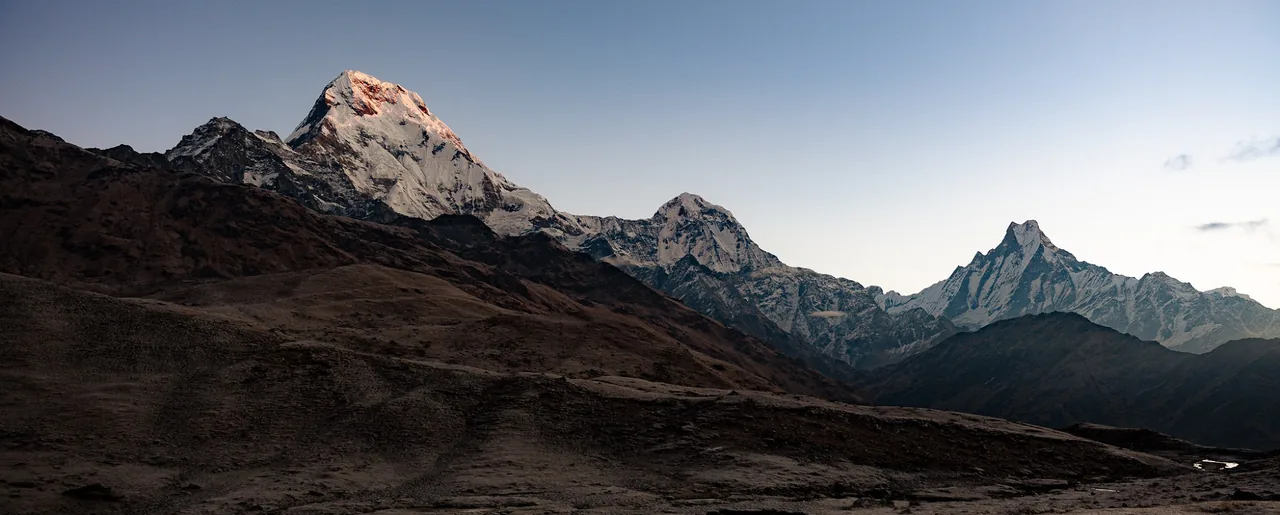
Almost every week someone walks into our office in Lakeside with the same question. They have four or five days, they want to see the big mountains up close, and they have narrowed it down to two names: Poon Hill and Mardi Himal. Both start from Pokhara, both are in the Annapurna Conservation Area, and both can be done without any climbing experience. They are still very different walks.
Here is how we explain the difference across the desk.
Poon Hill
- 4 days · 3 nights
- High point 3,210 m
- Stone staircases, forest and villages
- Busy teahouse villages
- Best first trek in Nepal
Mardi Himal
- 5 days · 4 nights
- High point about 4,500 m
- A narrow grassy ridge above the forest
- Small, simple lodges
- For fit walkers who want to go higher
How high you go
This is the biggest difference. Poon Hill tops out at 3,210 m, and you only stand there for the sunrise before walking down. You sleep at Ghorepani, 2,860 m. That is below the height where most people feel the altitude.
Mardi Himal keeps climbing. High Camp is around 3,580 m, the Upper Viewpoint about 4,200 m, and Base Camp roughly 4,500 m, right under the south face of Machhapuchhre. Most people feel the thin air on the last stretch: slower steps, a light headache, a pause every few minutes. It is manageable if you walk slowly and drink plenty, and the plan drops back to Low Camp the same day, but it is a real step up from Poon Hill.
What a walking day feels like
Poon Hill is famous for its steps. Between Tikhedhunga and Ulleri the trail climbs a long stone staircase, locals will tell you it is about 3,300 steps, and it is the part everyone remembers. After that the path runs through rhododendron and oak forest, past Magar and Gurung villages, with tea stops every hour or so. Days are four to seven hours.
Mardi starts in forest too, but on day three you come out above the trees onto a ridge that barely seems wide enough for the trail. From there to High Camp you walk with Machhapuchhre, Mardi Himal and Annapurna South in front of you the whole time. The base-camp day is the long one: an early start in the cold, seven or eight hours in total, and steep ground on the way down.
The views
Poon Hill is a sunrise trek. You leave Ghorepani around 4:30 in the morning with a head torch, climb for about 45 minutes, and watch the light reach Dhaulagiri and the Annapurna range from a crowded wooden viewing tower. On a clear October morning it is one of the great views in Nepal. On a cloudy one you see very little, with a four-day plan there is no spare morning, so some people add a day for a second chance.
On Mardi the mountains are with you for two full days, not one sunrise. You are much closer, too: at Base Camp Machhapuchhre fills the sky. Clouds often build by late morning, so the ridge days start early.
Where you sleep
Ghorepani and Tadapani are proper teahouse villages: twin rooms, hot showers in most lodges (for a small charge), a warm dining room with a stove, and a long menu. You will meet trekkers from everywhere.
Mardi's lodges are smaller and simpler, especially above Forest Camp: basic twin rooms, shared bathrooms, fewer menu choices, and properly cold nights at High Camp. In October and November it is worth booking early, because there are only a handful of lodges up there.
When to go
For both treks the clearest skies are from October to November. March to May brings the rhododendrons into flower. Poon Hill is especially red in April, with more haze in the afternoons. Winter (December to February) is quiet and clear, but Ghorepani nights are near freezing and Mardi's upper ridge can have snow and ice. From June to August the monsoon brings rain, cloud and leeches; Poon Hill is still possible, Mardi's ridge much less rewarding.
Permits and guides
Both treks are inside the Annapurna Conservation Area, so you need an ACAP entry permit: NPR 3,000 for foreign visitors and NPR 1,000 for SAARC nationals, issued by the National Trust for Nature Conservation. Since April 2023 foreign trekkers in Nepal's protected areas must also walk with a licensed guide, so solo trekking on either route is no longer an option. When you book with a local agency, the permit and guide are arranged for you before you leave Pokhara.
So which one?
Choose Poon Hill if it is your first trek, you are travelling with children (about eight and up do well) or older parents, you have four days, or you like the idea of villages, tea stops and a lively lodge at night.
Choose Mardi Himal if you already walk regularly, you have five days, you want to get above the tree line and close to the big peaks, and you do not mind simple lodges and a cold, early start.
And if you cannot decide: plenty of people do Poon Hill first and come back the next season for Mardi. Tell us your dates and how you like to walk, and we will help you pick, honestly, even if the answer is the shorter trip.
 Ask us on WhatsApp